CamEncoders is the Kit Encoder business of GDE Technology Ltd. Our experience spans both metal-target and resonant-target sensing. Our metal-target sensor IP is licensed to Balluff GmbH, Continental AG, and TT Electronics and ships inside their automotive and industrial linear sensor ranges.
For our Kit Encoders, we chose a resonant-target architecture to deliver better accuracy and wider installation margins. It turns a complex installation procedure into a simple screw-and-forget production step. The architecture is protected by a granted US patent.
Bring us the encoder requirement that is hardest to meet. Discuss installation, operating conditions and performance limits directly with the people who design the sensor, write the calibration firmware and specify the interface timing.
Bring your colleagues’ questions as well as your own. They are welcome to join the discussion.
The conversation can start while your design is still taking shape. We can work through mechanical fit and configuration options together, then discuss sample availability when you are ready to evaluate a Kit Encoder.
Resonant-target position sensing has deep Cambridge roots, reaching back to work at the technology consultancy Scientific Generics in the early nineties. Cambridge is also home to Zettlex and its resonant-target encoders.
Our own work across both metal-target and resonant-target sensing builds on twenty years of development. It produced tools for accurate PCB coil design, measurement algorithms for high rotation speeds and self-calibration across temperature.
We developed our patented self-calibration architecture for axes with restricted angular travel. Analogue-chain correction continues at a 400 Hz update rate even if the shaft is stationary. The sensing platform’s architect, Dr Victor Zhitomirsky, is a named inventor on more than twenty patent applications in smart sensing.
For our Kit Encoders, we use a resonant target to reduce the effect of direct breakthrough. Our multiturn coil design shapes the target’s sinusoidal electromagnetic field to reduce harmonics in received signals. The result is a tenfold reduction in non-linearity error within each fine-scale period.
Together with self-calibration of the analogue receive chain even at standstill, our Kit Encoders deliver wider installation margins and full datasheet accuracy on axes that dwell. A complex installation procedure becomes a simple screw-and-forget production step.

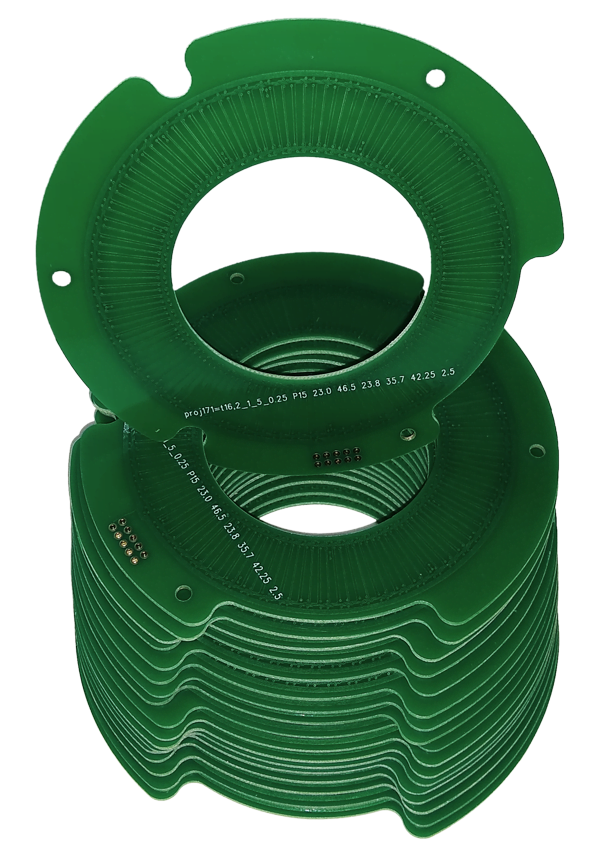
Stator PCB with excitation and receive coils.

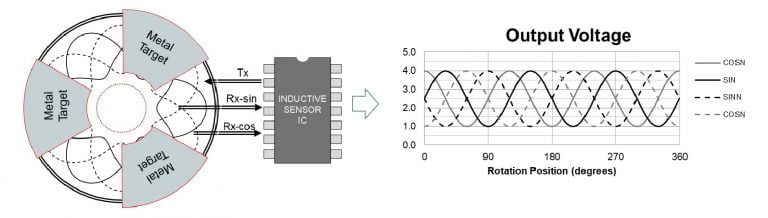
Need a compact design but can not afford the $250+ for Heidenhain metal target sensors? Why not build your own absolute encoders with a BOM cost below $25 in volume production?


Voltage supply
4.75…30 VDC
Reverse polarity protection
Yes, including any wiring faults
Short-circuit proof
Yes
Consumption w/o load
≤60 mA (5 VDC)
Power consumption
typ. 0.3 W
Function
Interface
Steps per revolution
Number of revolutions
Absolute accuracy
Repeat accuracy
Sensing method
Inductive, metal target
Input signals
Output stage
RS422
Output signals
Clock frequency
SSI configuration
SSI Multipath transmission
Yes
Internal cycle time
Fixed latency
Group delay
Full transient
Cyclical scanning
Gain mismatch in receive channels
Breakthrough in receive channels
Interference immunity
EN 61000-6-2
Dimension
Working temperature
Max. rotational speed
24,000 rpm
Installation height
Form factor
Typical through hole size